The Dalai Lama signals China should stay out of divine succession process
17, Jun 2026The Dalai Lama said Wednesday that the ancient Tibetan Buddhist institution he leads will live on after he dies, putting an end to speculation that he would be the last person to hold the role as he plans to reincarnate.
As part of celebrations marking his 90th birthday, the Dalai Lama, a Nobel Peace Prize laureate, also signaled that China, which Tibetan activists accuse of suppressing their language, culture and religion, should stay out of the process of choosing his successor.
“I am affirming that the institution of the Dalai Lama will continue,” said the Dalai Lama, who has spent almost 70 years living in exile in India after he fled Tibet, an autonomous Himalayan region of China.
“I hereby reiterate that the Gaden Phodrang Trust has sole authority to recognize the future reincarnation,” he said, referring to an organization he founded. “No one else has any such authority to interfere in this matter.”
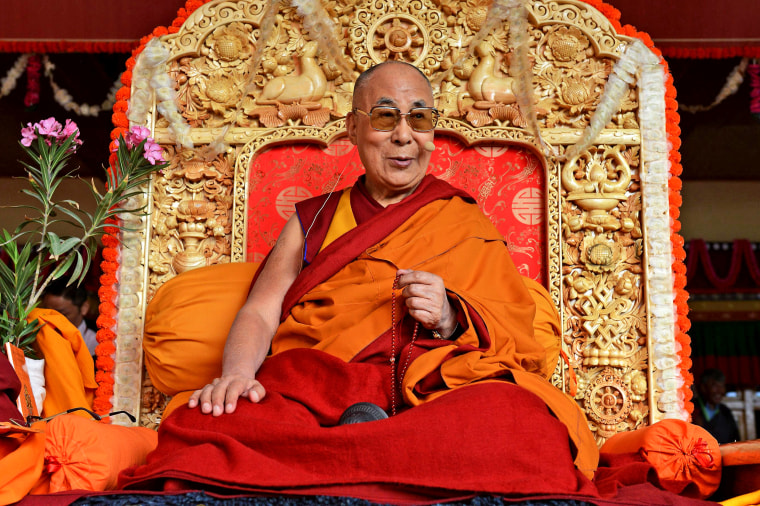
Anxiety is mounting over who will follow him as the spiritual leader of Tibetan Buddhism, in which he is worshiped as a living manifestation of Chenrezig, the Buddhist god of compassion. His succession plan is likely to have an impact on Tibetans opposed to China’s tight control of the Himalayan autonomous region.
The Chinese government responded to the comments swiftly, with a spokesperson for the Foreign Affairs Ministry saying the Dalai Lama must be reincarnated “in accordance with Chinese laws and regulations.”
The succession must take place in mainland China and get approval from the central government, spokesperson Mao Ning said at a daily briefing in Beijing.
The Dalai Lama made the announcement days ahead of his 90th birthday on Sunday, after a conference of representatives of the four major traditions of Titbetan Buddhism in the Indian city of Dharamsala, the seat of the Tibetan government-in-exile.
It’s unusual for a living Dalai Lama to talk about his successor, the search for whom begins only upon his death because it involves reincarnation. But as the 14th Dalai Lama grows older, there is growing worry that the Chinese government could take advantage of a gap in leadership.
“I think His Holiness feels the need to reassure people by basically letting them know that he is thinking about the succession,” Thupten Jinpa, his English translator of four decades, said in a phone interview from India last week.
Identified as a baby in 1937, the 14th Dalai Lama was formally recognized two years later. In addition to his role as spiritual leader, he was temporal leader of Tibet starting in 1950, when he was 15 and China began annexing the region.
In 1959, when he was 23, the Dalai Lama and thousands of other Tibetans fled to India after a failed uprising against Communist rule, eventually settling in Dharamsala.
Since the 1970s, the goal of the movement has shifted from Tibetan independence to achieving genuine autonomy within China. In recent years, the Dalai Lama has also stepped down from his political role, which is now a democratically elected position.
In March, he said in a new book that his successor would be born in the “free world” outside China so that the traditional mission of the Dalai Lama could continue. According to the Central Tibetan Administration, there are about 130,000 Tibetan exiles around the world, mostly in India and Nepal.
The Dalai Lama had said in 2011 that the institution of the Dalai Lama did not necessarily have to continue at all and that he would leave it up to the Tibetan Buddhist community.
Since then, he has received appeals from a variety of constituencies, and the “unanimous” response, Jinpa said, has been that there should be a 15th Dalai Lama.
“For the Tibetan people, his name has come to symbolize the nation,” said Jinpa, who has assisted the Dalai Lama with a number of books, including the recent “Voice for the Voiceless.”
There is also concern that if they do not select a new Dalai Lama, China could name one who goes unchallenged.
“Sadly, the PRC government probably will want to play a role, just as it inserted itself in the process of the recognition of the Panchen Lama,” Jinpa said, referring to the second-highest spiritual leader in Tibetan Buddhism.
In 1995, the Dalai Lama recognized a 6-year-old boy in Tibet as the 11th Panchen Lama, six years after the previous one died. The boy was forcibly “disappeared” by the Chinese government three days later, rights groups say, and has not been seen in public since.
China then chose its own Panchen Lama, imposing him on the 6 million people in Tibet.
The Tibetan government-in-exile does not recognize the Beijing-appointed Panchen Lama, who rarely appears in public but pledged loyalty to the Chinese Communist Party in a closed-door meeting last month with President Xi Jinping, state media reported.
If Beijing also tries to name a Dalai Lama, “Tibetans would not be surprised,” Jinpa said. “They would be disappointed and annoyed, but I don’t think they would be surprised.”
The Chinese government says that Tibet has prospered under its rule and that it has improved infrastructure and social conditions and promoted economic development. It says that the Dalai Lama is “a political exile engaged in separatist activities under the guise of religion” and that the reincarnation of Tibetan lamas should be controlled by Beijing.
China’s Foreign Affairs Ministry said the Dalai Lama must be reincarnated “in accordance with Chinese laws and regulations” that Beijing claims aim to protect the tradition and religious freedom.
The succession must take place in mainland China and get approval by the central government, Mao, the ministry spokesperson, said Wednesday.