Trump says Gaza ceasefire still in place after Israeli strikes
08, Jun 2026President Donald Trump insisted Sunday night that the ceasefire in Gaza was still in place after Israel launched strikes in the enclave and traded accusations with Hamas that each side had violated the fragile truce he helped broker.
"We wanna make sure that it's going to be very peaceful with Hamas," Trump told reporters onboard Air Force One late Sunday after Israel carried out a wave of strikes in response to what it said were a series of Hamas attacks on Israeli forces in the southern Gaza city of Rafah.
The Israel Defense Forces confirmed Sunday that it had begun "renewed enforcement of the ceasefire" after the first major test of the deal.
Trump said Washington believed that Hamas leadership may not have been involved in the alleged violation of the truce after Israel accused the militant group of killing two soldiers beyond the "yellow line," referring to the boundary within Gaza that Israeli troops have withdrawn to under the first phase of the truce.
Asked whether the Israeli strikes that followed the incident were justified, Trump said, "I'd have to get back to you on that," adding that the matter was "under review." He said the situation was “going to be handled toughly, but properly.”
As fears grew in the region that the 10-day-old ceasefire agreement could collapse, Trump’s special envoy, Steve Witkoff, and Jared Kushner, the president’s son-in-law, landed in Israel, where they met with Israeli Prime Minister Benjamin Netanyahu, according to a spokesperson for his government.
The spokesperson added that Vice President JD Vance and his wife, second lady Usha Vance, were also expected to make a trip to Israel.
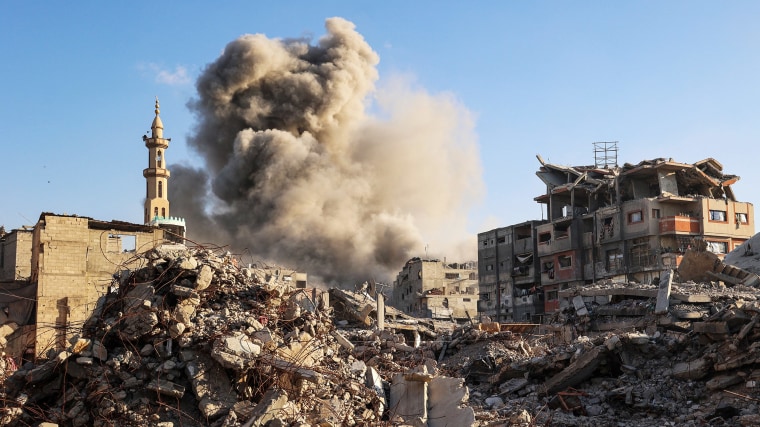
Hamas' failure to return all of the bodies of deceased hostages held in Gaza had already put a strain on talks to advance to a second stage of the deal.
Hamas returned the body of one more hostage via the Red Cross on Monday, according to the IDF.
"The coffin of the deceased hostage, escorted by IDF troops, crossed the border into the State of Israel a short while ago and is on its way to the National Institute for Forensic Medicine, where identification procedures will be carried out," the IDF said on X.
If the body returned by Hamas on Monday is confirmed to be one of the hostages, then the bodies of 15 deceased hostages still remain in Gaza.
The difficulty of locating remains of deceased hostages amid the rubble of Gaza had been raised by both Hamas and the International Committee of the Red Cross, which has helped facilitate the release of hostages held in Gaza in exchange for Palestinian prisoners and detainees held by Israel.
Israeli barriers to more aid entering Gaza, another key tenet of the agreement, have also been a point of contention. An Israeli security official said Monday that aid would enter the famine-stricken territory through the Kerem Shalom crossing, while the Rafah crossing remained closed.
But after days of mounting tensions, Sunday's strikes posed a sudden and significant threat to the deal.
A spokesperson for the Palestinian Health Ministry in Gaza told NBC News on Sunday that at least 23 people had been killed in Israeli attacks that day.
Hamas denied any involvement in the incident in Rafah and emphasized its commitment to the truce, while a senior official accused Israel of working to “fabricate flimsy pretexts” for its own assault.
Hamas' government media office accused Israel of committing "80 violations" of the ceasefire since it began, which it said had killed dozens of people and wounded hundreds in just over a week.