You may have missed your chance to see the light show over U.S. skies from geomagnetic storm
08, Jun 2026Anyone who suffers from the fear of missing out will be left disappointed as another chance to catch the remarkable show from energized solar particles hurling toward the Earth and lighting up the skies appears unlikely.
The dazzling displays reached as far as Florida on Tuesday, but forecasters said that Wednesday evening was most likely the last opportunity for much of the U.S. to spot the rare atmospheric show.
The aurora could be visible as far as Alabama to northern California, the Space Weather Prediction Center said in an advisory on Wednesday afternoon. Forecasters added that the “final and most energetic CME,” meaning coronal mass ejection, had arrived Wednesday.
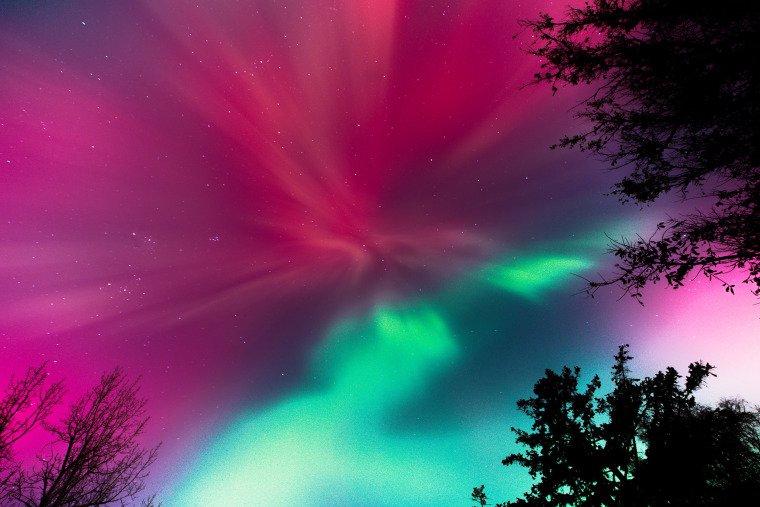
A CME is an eruption of massive clouds of protons, electrons and magnetic fields from the sun’s outer atmosphere at very high speeds.
“This latest CME [has] arrived. It’s faster than the previous CMEs and our wind speeds have shot up over 800 kilometers (497 miles) per second,” Shawn Dahl, a forecaster at NOAA’s Space Weather Prediction Center in Boulder, Colorado, said in a video posted on X.
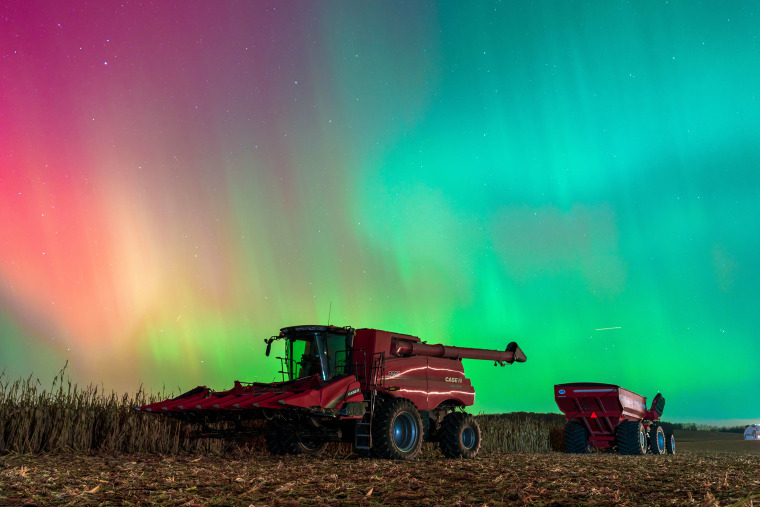
When it reaches the Earth’s magnetic field, also called the magnetosphere, it collides with the particles around the planet, producing colorful light known as aurora borealis in the Northern Hemisphere and aurora australis in the Southern Hemisphere.
The third CME has reached a G3 rating and has the capability to obtain a G4 rating — the second-highest rating on a five-step scale that the two previous CMEs reached.
Tuesday’s activity was “eight to 10 times stronger than normal background levels for a magnetic field,” Dahl said. “This one is about five times stronger so not as intense.”